A2UI vs. Vercel AI SDK (2026 Edition): Architecture Deep Dive & Selection Guide
Confused between A2UI and Vercel AI SDK? Learn why one is a "Native-First Protocol" and the other is a "Web Toolkit," featuring the latest 2026 CopilotKit ecosystem updates.
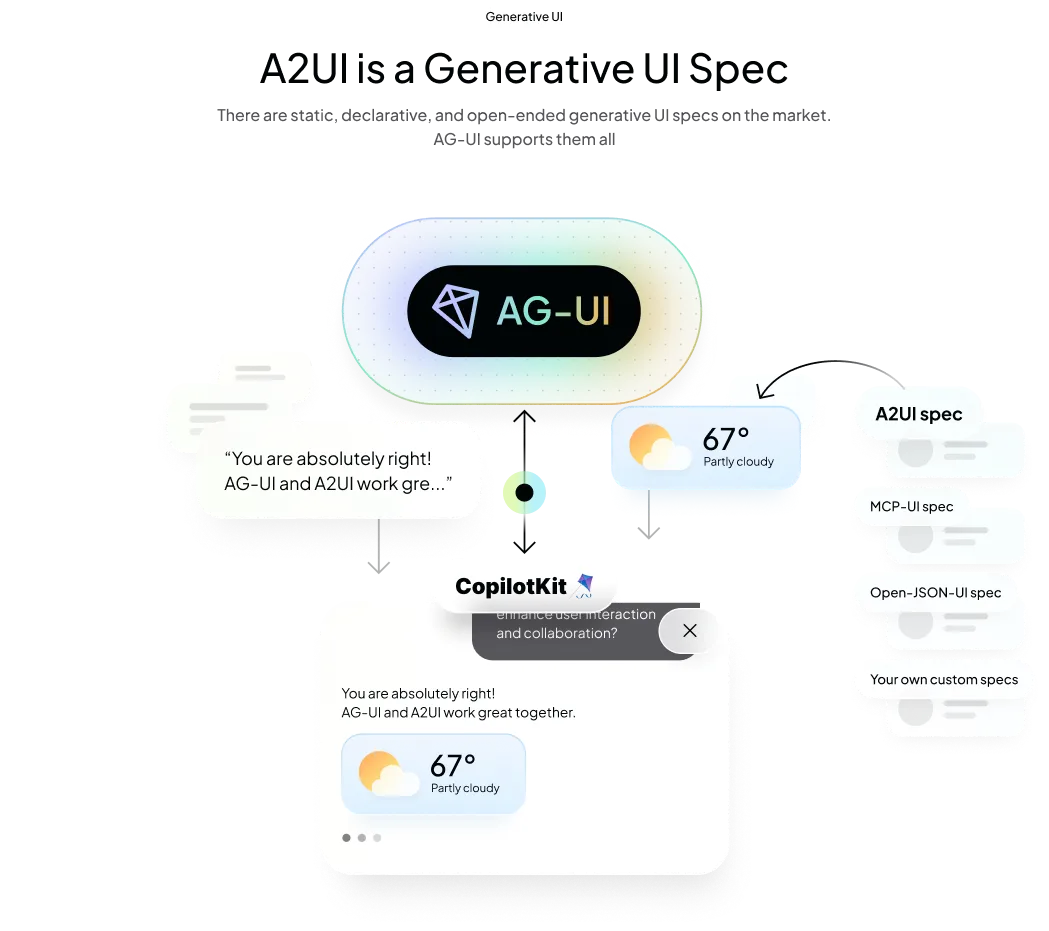
In the rapidly evolving world of Agentic AI, two names often come up in the same conversation: Google’s A2UI and Vercel AI SDK’s Generative UI.
If you are a developer tasked with building the next generation of AI apps, you might be asking: “Which one should I use? Are they competitors?”
The short answer is: They are not zero-sum competitors. They are complementary solutions with fundamentally different design philosophies.
- Vercel AI SDK is a Web-Centric Toolkit, unparalleled in the Next.js ecosystem.
- A2UI is a Native-First Protocol, designed to solve cross-platform (Mobile/Web/Desktop) and security isolation challenges.
⚠️ 2026 Status Update (As of Jan)
August 2026 status: v0.9.1 is the current production release, v1.0 is a candidate, and v0.8 is legacy.
- Ecosystem Explosion: CopilotKit has announced it is a Launch Partner for A2UI, providing you with an out-of-the-box React orchestration layer.
- React Support: While the official React Renderer is scheduled for Q1/Q2 release, you can use A2UI in React today via CopilotKit. Check out our A2UI React Renderer Roadmap for more details.
The Core Distinction: Framework-Bound vs. Protocol-Driven
Vercel AI SDK & json-render: The Web-Centric Stack
The Vercel AI SDK is an outstanding toolkit for orchestration, managing LLM streaming, chat sessions, and tools in JavaScript runtimes.
In early 2026, Vercel transitioned its Generative UI strategy. They open-sourced json-render and paused development on the original React Server Components (RSC) direct-streaming paradigm. Under the new pattern, the LLM outputs schema-validated JSON (typically via Zod) which the client maps to a catalog of pre-registered components. However, json-render remains tightly bound to the JavaScript/Web ecosystem (React, Vue, Svelte, and React Native via JS bridges).
A2UI: The Platform-Agnostic Protocol
A2UI (Agent-to-User Interface) is a pure data protocol specification. It defines a standard, highly optimized JSONL messaging format for UI intent. It is entirely runtime-independent and does not care whether the transport is HTTP, WebSockets, or local IPC, nor does it care about the frontend framework.
For a deeper dive into why the protocol utilizes JSON, read our article: Why A2UI Uses JSON Instead of HTML/JSX.
| Feature | Vercel + json-render | A2UI |
|---|---|---|
| Core Philosophy | Web-Centric (JS-First) | Native-First (Platform-Agnostic) |
| Transport Format | Zod-validated JSON | Streamed JSONL Specifications |
| Client Support | Primarily Web (React, Vue, Svelte, React Native) | Any native engine (Flutter, SwiftUI, Jetpack Compose, Web) |
| Styling Control | JS-runtime styles or raw CSS overrides | Native Theme Declarations in v0.9 |
| Security Boundaries | Relies on client-side JS validation | Component Registry Firewall |
| Primary Use Case | Rapid Next.js/React-centric web development | Cross-platform, high-security enterprise apps |
Deep Dive: “Native-First” vs. “Web-Centric”
This is the key decision factor for 2026.
Web-Centric (Vercel) excels in speed of web development. If you are building a React-only web dashboard, streaming JSON to client-mapped components via json-render is incredibly fast. But its main limitation is platform lock-in. If your company decides to launch a native iOS App (SwiftUI) or a native Android App (Jetpack Compose), Vercel’s Javascript-driven schemas cannot be natively parsed and drawn without heavy, slow webviews or JS engines running on mobile.
Native-First (A2UI) excels in universality. Because A2UI translates UI strictly into declarative schemas, the same JSON payload streamed from your agent:
{ "type": "flight-card", "props": { "flight": "UA123" } }- On Web, it maps to standard Web Components or React cards.
- On iOS, the native rendering engine compiles it to a SwiftUI view.
- On Android, it renders as a native Jetpack Compose view.
Security: Declarative Schemas vs. Script Injections
While Vercel’s newer json-render reduces the security risk of old RSC code execution by moving to JSON props, it still lacks the strict Component Firewall design of A2UI.
Under A2UI, the agent can invoke only components exposed by the client’s local catalog. This reduces the UI shapes available to a compromised agent, but permitted components and misleading content still require policy controls. For audited environments such as finance and healthcare, the catalog provides an explicit review boundary. See the production security guide.
Code Showdown
Let’s look at how an Agent “renders” a weather card in both approaches.
Approach 1: Vercel AI SDK with json-render
// Server-side Zod Schema defining the UI props
import { z } from 'zod';

export const WeatherSchema = z.object({
  location: z.string(),
  temperature: z.number(),
  condition: z.enum(['Sunny', 'Cloudy', 'Rainy'])
});

// The agent generates JSON that fits this schema, and json-render maps it
// to a client-side React <WeatherCard /> component.
Approach 2: A2UI (JSONL Protocol)
// Streamed JSONL from the A2UI agent
{"surfaceUpdate":{"surfaceId":"weather-box","components":[{"id":"w1","component":{"type":"WeatherCard","props":{"location":"SF","temp":72,"cond":"Sunny"}}}]}}
{"beginRendering":{"surfaceId":"weather-box"}}
The A2UI Client (whether React, SwiftUI, Compose, or Flutter) resolves “WeatherCard” in its local trusted registry and draws it natively.
The Integration: Stream via Vercel, Payload via A2UI
You do not have to choose just one. In 2026, the industry best practice for complex web apps is to use Vercel AI SDK to orchestrate streams, but format the payloads using the A2UI specification.
By combining the two, your backend logic remains platform-neutral and secure, while your Next.js server utilizes Vercel’s streaming pipelines to deliver real-time experiences to React, Flutter, and iOS endpoints alike.
To see how to orchestrate multi-step agent actions with this setup, check out our guide on Integrating AG-UI with A2UI in CopilotKit.
Decision Guide (2026 Edition)
graph TD
    A[Start: I need to build an AI Agent UI] --> B{Do I need Mobile/Native support? <br/>(iOS/Android)}
    B -- Yes --> C[**Must use A2UI**<br/>(True native cross-platform rendering)]
    B -- No, Web Only --> D{Is it a high-security industry?<br/>(Finance/Enterprise/Healthcare)}
    D -- Yes --> C
    D -- No, I want Next.js speed --> E{Is the team React-exclusive?}
    E -- Yes --> F[**Prefer Vercel json-render**<br/>(High dev efficiency)]
    E -- No --> G[**Use Vercel SDK to transport A2UI**<br/>(Best flexibility)]
Conclusion
- Choose Vercel json-render: If you are a web-only shop, fully committed to JavaScript, and prioritize development speed.
- Choose A2UI: If you require a true native experience on mobile and desktop, need strict protocol neutrality, or work under rigorous security audit conditions.
- Combine Both: The modern consensus—use Vercel for the network pipeline and A2UI as the universal payload standard.
Related Reading: